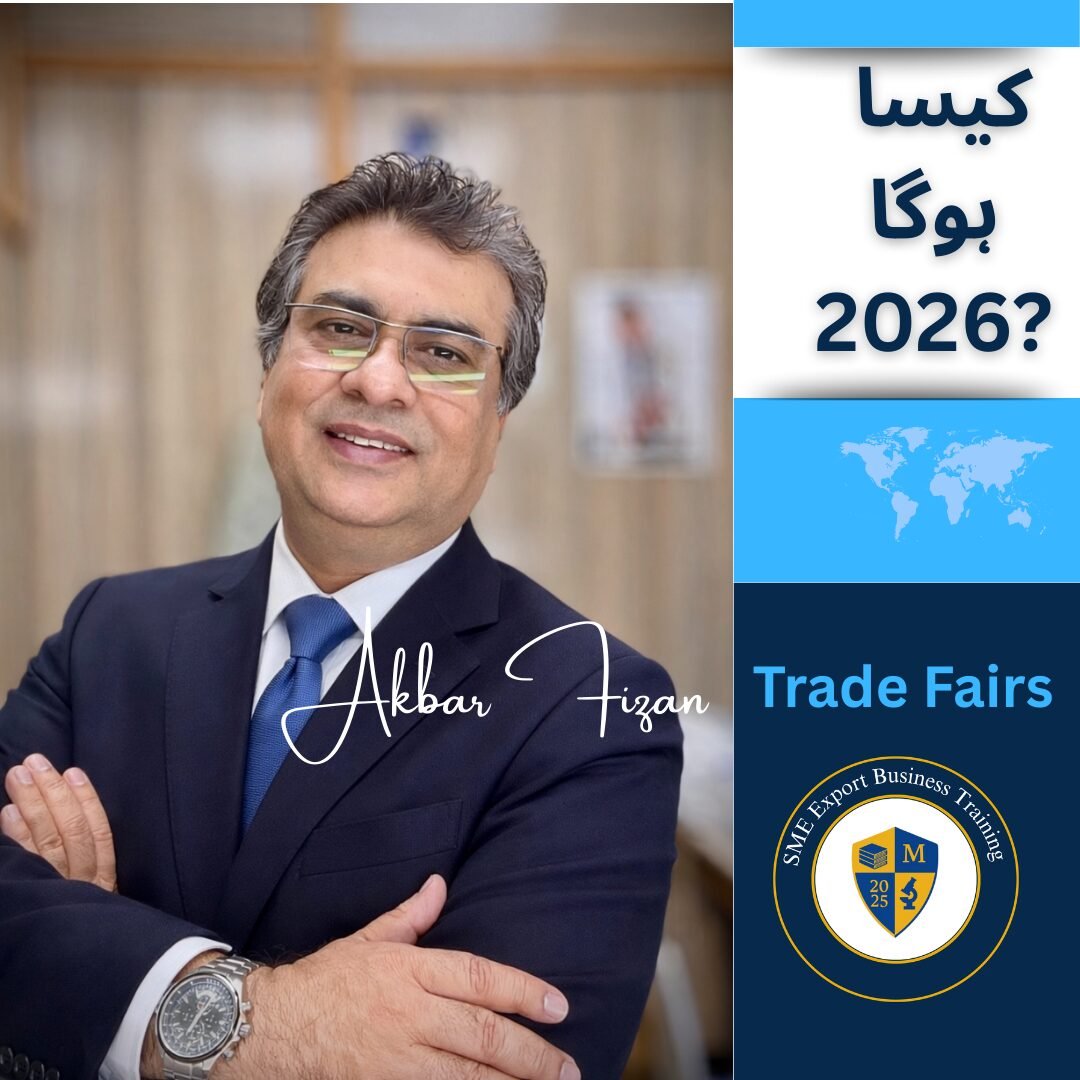
Global Trade Fairs 2026 and Sialkot Exporters: The Inevitable Need for a New Strategy
Written by: Fizan Akbar
The global business landscape has changed rapidly, and with it, the nature of international trade fairs has transformed completely. These exhibitions are no longer limited to setting up stalls, distributing catalogs, and holding formal meetings. By 2026, trade fairs have evolved into full-scale strategic arenas where only those exporters can succeed who enter with modern knowledge, technical expertise, and a clear, well-defined strategy. Sialkot, which has remained an important export hub of Pakistan for decades, still possesses immense potential. The real question, however, is whether we are utilizing this potential in the right direction or not.
In today’s era, it is no longer sufficient for an exporter to simply manufacture a good product. Along with modern and technical knowledge, there is a need to acquire a specialized skill that can be referred to as an “Exhibition Skill.” This is the skill that enables us to perform at international trade fairs what we were unable to achieve in 2024 and 2025. Unless we change our methods, mindset, and presentation, we cannot correct our strategy, nor can we secure the business we have been hoping for.
Before entering any new market, it is essential to conduct a complete and in-depth analysis of business competitors, particularly those who are actively exhibiting there. A proper SWOT analysis helps us understand in which products competitors are ahead of us and where their real strengths lie. This analysis is not only for gathering information but also for identifying our own weaknesses and opportunities.
A realistic and effective competitor analysis cannot be done while sitting in an office. In the country where business is intended, it is necessary to personally observe where competitors are strong and in which areas they are weak. Unfortunately, many exporters participate in international exhibitions in different countries without adequate research and development. When they fail to properly evaluate their competitors or accurately judge competing products, they are unable to position themselves effectively in the market.
As a result, our exporters may be present at exhibitions, but the business goes to someone else. On the other hand, exhibitors who arrive with thorough preparation, a clear strategy, and strong groundwork not only attract attention but also secure orders and establish long-term business relationships. This difference ultimately becomes the dividing line between success and failure.
The year 2025 is almost coming to an end, and this moment compels us to reflect seriously. If we continue to attend international exhibitions in 2026 without research, without development, and without a new strategy—and if we continue to display our products in the same way we did in 2024 and 2025—then it is certain that our business will remain stuck exactly where it stood in previous years.
The greatest need of this era is to develop a strong and practical strategy. Such a strategy will not be formed through thinking or wishful ideas alone; it requires a dedicated team, continuous research, product development, and organized planning. Unless we view the stages before, during, and after exhibitions as a complete system, international trade fairs will not be able to deliver real value for us.
In conclusion, it would not be an exaggeration to say that if Sialkot exporters participate in global trade fairs in 2026 with a new mindset, modern knowledge, and the right strategy, these exhibitions will no longer remain a source of expense. Instead, they will transform into real, sustainable, and profitable business opportunities. The year 2026 is a decisive one—either we remain where we are with old methods, or we move forward with a new strategy and establish a strong presence in the global market.